
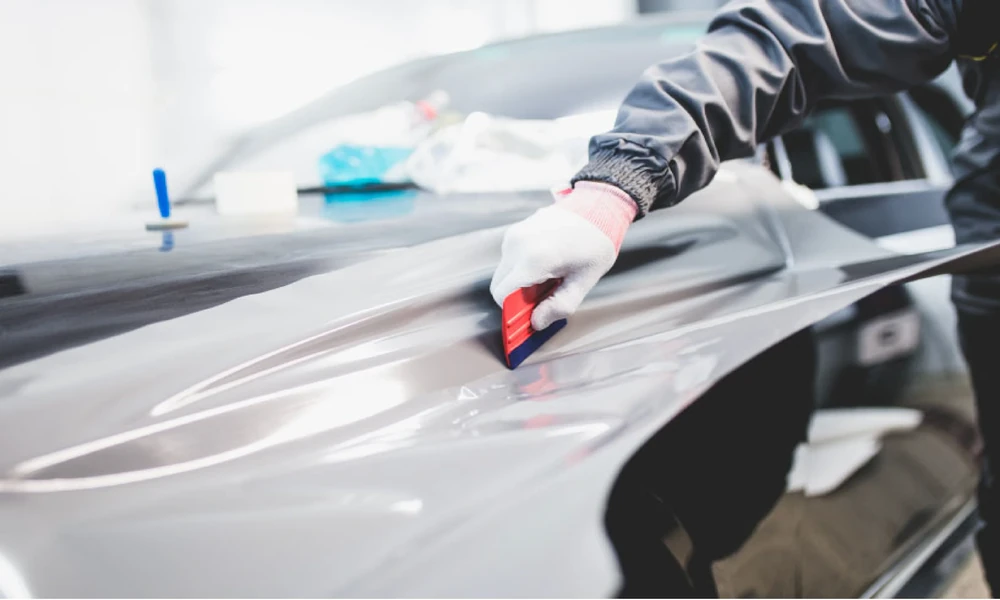

Before-and-after wheel photographs are most useful for exploring appearance and communicating a goal. They can show the kind of visible change a repair or refinish may produce, but they cannot establish your wheel’s condition or guarantee an identical outcome. Look for relevant examples, notice how the images were made and take the useful comparison into an individual assessment.
Match the kind of change, not just the dramatic result
A dramatic transformation attracts attention, but it may not answer the question you are asking. A complete colour change is different from restoring a small scraped area while preserving the surrounding finish. A heavily worn set being refinished is different from trying to match one wheel to three existing ones. Start by identifying the category of change you want to understand.
Read any accompanying explanation. Does it identify the work performed, the original finish or the reason for the broader scope? A pair of images without context can still be visually useful, but it leaves more unanswered. Avoid filling those gaps with assumptions that the provider has not made. The image may show a pleasing result without explaining the condition or decisions that led to it.
Choose examples that help describe a preference, not just examples you admire. You might like how a restored edge blends with the face, how a silver finish preserves the spoke design or how an understated colour suits the vehicle. Those observations can be discussed. Saying only “make mine look like this” can conceal important differences between the reference wheel and your own.
The wheel design matters as a visual reference. A similar finish can read differently on a wide-spoke design than on one with many narrow surfaces. A photograph of a different design should be treated as an idea rather than a preview. The provider can help explain which parts of the effect are relevant to the wheel you bring in.
Lighting and framing belong in the comparison
Before and after pictures are easier to interpret when the viewing conditions are reasonably comparable. A close-up in harsh light and a distant photograph in soft light can make a result difficult to judge. This does not automatically make the images misleading. It simply means the viewer should be careful about attributing every visible difference to the work itself.
Notice whether the same area of the wheel is shown. A scraped edge may be prominent before the work but partly outside the frame afterwards. If the detail you care about is not visible, the photograph cannot answer your question about it. Ask for clarification or a more relevant example rather than assuming the missing view confirms the result you hope for.
Colour comparisons deserve particular restraint. A phone screen, image processing and reflections can change the impression of a metallic or dark finish. A gallery can help select a direction, but an actual sample or the provider’s defined finish description may be needed for approval. Do not demand a precise colour match to a screen image that was never intended as a colour standard.
Look at both the detail and the whole vehicle where images are available. Detail views can explain workmanship and appearance around the affected area; wider views help you judge style and proportion. Each answers a different visual question. A useful gallery visit moves between those scales instead of relying on whichever photograph creates the strongest first impression.
The unseen work remains unseen
A photograph records visible appearance at a moment in time. It does not by itself establish the wheel’s repair suitability, the inspection performed or every step involved in the work. If your concern includes a bend, crack or a change in vehicle behaviour, those matters need an appropriate assessment. A polished after image cannot supply that assessment for a different component.
The same limit applies to durability. An image of a newly finished wheel shows how it looked when photographed, not how every finish will respond to every owner’s use and care. Ask the provider about the service supplied and its relevant guidance. Avoid converting an attractive picture into an unstated promise about lifespan, maintenance or future damage.
Price is another unseen element. The example may have involved a different scope, wheel condition or associated work from your project. A gallery should not be used to infer a total cost simply because the visible damage looks similar. A defined estimate for your own wheels remains necessary if price is part of the decision.
These limits do not make visual examples unhelpful. They make their role clearer. Photographs can show what the provider wants prospective customers to understand about appearance. Technical recommendations, pricing and the agreed work need their own evidence. Keeping those roles distinct lets you use a gallery with interest without asking it to prove more than it contains.
Take one useful example into the assessment
Onyx Rims’ before-and-after page explicitly states that gallery photographs are examples rather than guarantees and that results depend on the wheel, finish, damage and method. For owners in Toronto or Mississauga, that is a sensible way to use such a page: select a relevant visual reference, then ask how it relates to the component that will actually be assessed.
Explain what part of the example matters to you. Perhaps it is the preservation of the original look or the consistency of a complete finish. The provider can then discuss whether that goal is realistic, what work it would involve and what differences to expect. A focused reference often starts a better conversation than a large folder of unrelated transformations.
Leave the assessment with a description of your own project, not merely a link to someone else’s result. The useful outcome of browsing is a clearer preference and a better question. When the example helps both sides define the intended appearance while leaving the condition decision to the actual wheel, the photographs have earned their place in the research.



Leave a Comment