
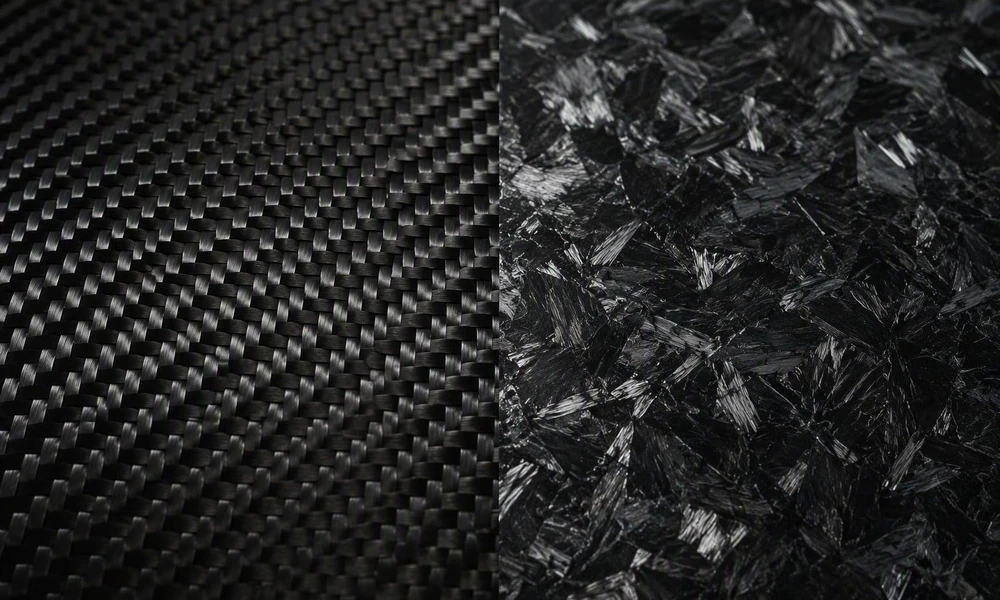

Your part has never existed before. Neither has anyone else’s.
Every woven carbon hood ever made looks like every other woven carbon hood. Same twill, same shimmer, same checkerboard order. Now look at two forged carbon parts side by side: same mold, same material, same process, and yet the marble patterns are completely, provably different. Forged carbon is the only mass-producible material where every single part is a one-off. That accident of physics is quietly changing what exclusivity means.
Why Randomness Cannot Repeat
The uniqueness is not a feature someone designed, it is entropy, manufacturing edition. Chopped fibers, each 10 to 50 millimeters long, are mixed with resin and placed into the mold as a compound. Under pressure, they flow and settle wherever physics puts them. There is no pattern to control because there is no pattern at all. Just thousands of fibers in frozen Brownian motion. The odds of two parts settling identically are lottery-in-reverse: effectively zero. The forged carbon process explains the mechanics; the aesthetic is the free gift.
What Authenticity Is Worth
Car culture has always paid for uniqueness. Numbered editions, custom paint, one-off interiors. The market premium for ‘nobody else has this’ is one of the industry’s oldest facts. Forged carbon delivers a version of it structurally: not a numbered plaque claiming rarity, but a physical surface that cannot be duplicated, verified by inspection rather than certificate. Your forged engine cover is not edition 247 of 500. It is edition one of one, forever, because the alternative is physically impossible.
The Counterfeiting Angle
Uniqueness cuts the other way too, and in the owner’s favor: the pattern is brutally hard to fake well. Printed forged-look vinyl and hydro-dip exist, but up close they repeat, and repetition is the tell. The same marble whorl appearing twice on one part is impossible in the real process. Genuine forged carbon carries its authentication on its face. In a market where fake carbon fiber spotting is a necessary skill, a surface that self-authenticates is worth real money.
Living With a Part Nobody Else Has
There is a subtle ownership pleasure here that spec sheets miss. Woven carbon parts are beautiful but interchangeable. The satisfaction is in the material, not the instance. A forged part is yours in a stronger sense: photographed, documented, recognizable. Owners of forged pieces report the same odd attachment people feel for figured wood or natural stone. The pattern becomes the part’s name. Sentimental? Perhaps. But objects that cannot be replaced are owned differently than objects that can be reordered.
Why Weave Could Never Offer This
It is worth pausing on why woven carbon, for all its virtues, cannot play the uniqueness game. The weave is a grid, and grids repeat. Two twill hoods from the same fabric roll are visually interchangeable, which is exactly what manufacturing wants and exactly what exclusivity cannot use. The woven part’s beauty is its order; the forged part’s beauty is its chaos. Neither is better. But only one of them can promise that your part has never existed before, and that promise turns out to be the one buyers remember.
The Camera’s Favorite
There is a practical dividend in the social-media era: forged carbon photographs like nothing else. The marble pattern holds interest at every zoom level, reads clearly in any light, and is instantly identifiable in a thumbnail. Woven weave often moires and flattens on camera; forged marble just gets more interesting. For builders whose cars live partly online, which is to say, most builds now, a material that is photogenic by accident is a genuine feature. The pattern was never designed for the feed. It simply could not have been designed better for it.
The Design Consequence
Designers are learning to work with the randomness rather than fight it. Because the pattern cannot be controlled, it cannot be criticized. No one complains that the marble swirls left instead of right. This liberates the aesthetic: the material does the styling, and the designer curates the shape, the finish, and where the material appears. Several supercar interiors now use forged carbon precisely where the eye lands first, letting physics sign the dashboard like an artist who never repeats a canvas.
Where Uniqueness Matters Most
- Hero parts: engine covers, interior centerpieces. Where the eye lingers and the story gets told.
- Numbered and special builds: where provable one-off surfaces match the car’s own claim.
- Personal flagship pieces: the one part you buy to keep, not to sell.
Mass production spent a century making every part identical, and called it quality. Forged carbon makes every part different, and calls it inevitable. Between those two ideas sits a genuine novelty in manufacturing history: exclusivity that costs nothing extra, because physics already paid for it. Your part will never have a twin, and in a hobby built on standing out, that might be the best value in the entire catalog.

Leave a Comment